
LANDSCAPE DESIGN 4
Environmental Analysis and Planning
This course studies the methods and attitudes of environmental research and analysis utilized by landscape architects. Students investigate the natural, historical, and cultural factors that impact land-use suitability, design programming, and design development. Instruction emphasizes the application of these methods to both the natural and built environments.
INSTRUCTOR: Emily Gabel-Luddy & Soo Wai Kin
JUDGES:
Derek Lazo
SCRIBES:
Jonathan Rosetti
Johnny Carson Conservation Park
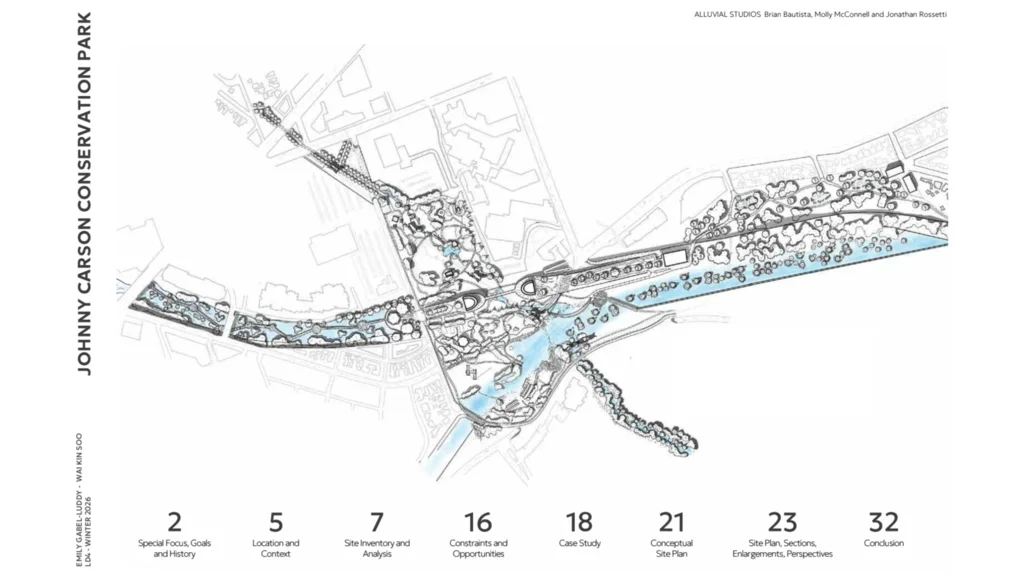
Brian Bautista, Molly McConnell & Jonathan Rossetti
The program for this class required us to design specifically for animals ranging from lizards all the way up to apex predators like Mountain Lions. The design addresses a hypothetical scenario in 2040 where the 134 freeway has been shut down from decreased car demand due to improved public transportation. We were allowed to create design solutions along the shuttered 134 freeway, but our final deliverable was to focus on repurposing Johnny Carson Park to be better used by fauna, including humans. Once we researched animals like Mule Deer and Mountain Lions we realized our design intervention would need to connect isolated areas like Griffith Park with habitat corridors to allow animals to safely transit from Griffith Park to the Angeles National Forest to prevent genetic inbreeding, population collapse and wildlife-vehicle collisions.

SCASLA - Excellence Award
Judges particularly liked the Puma Power lines. The project was clear and ambitious and well thought out. The hand graphics were evocative and commended.
Johnny Carson Park
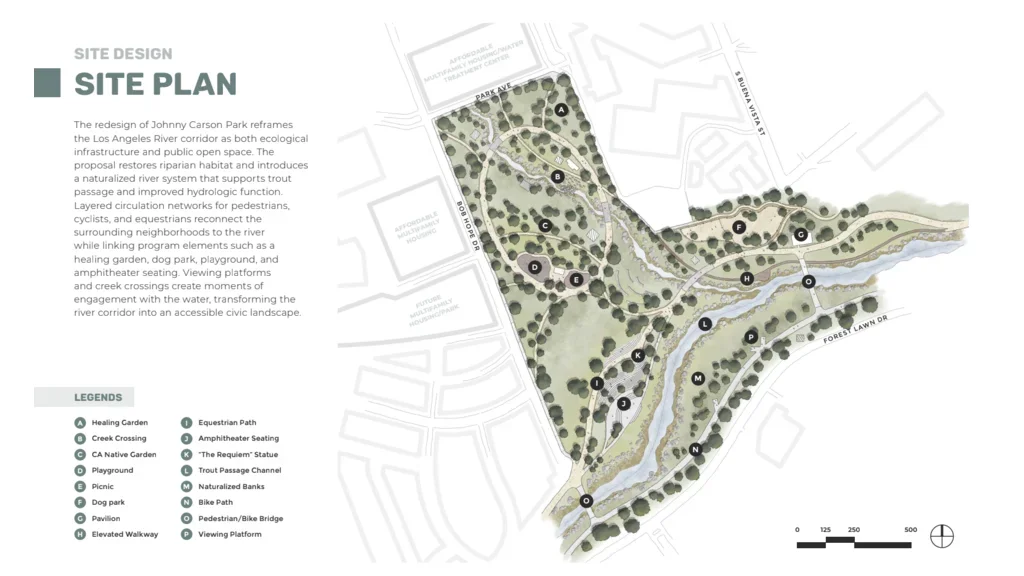
Laura Williams, Marissa Vega, James Kang

SCASLA Achievement Award
Judges felt the imagery was evocative, with cohesive graphics and clear thinking.
Our team had a special focus of incorporating the history of the LA River into our design. The course assigned a future Los Angeles scenario in which the city is less car-dependent and the 134 Freeway is decommissioned.
Johnny Carson Park Reimagined
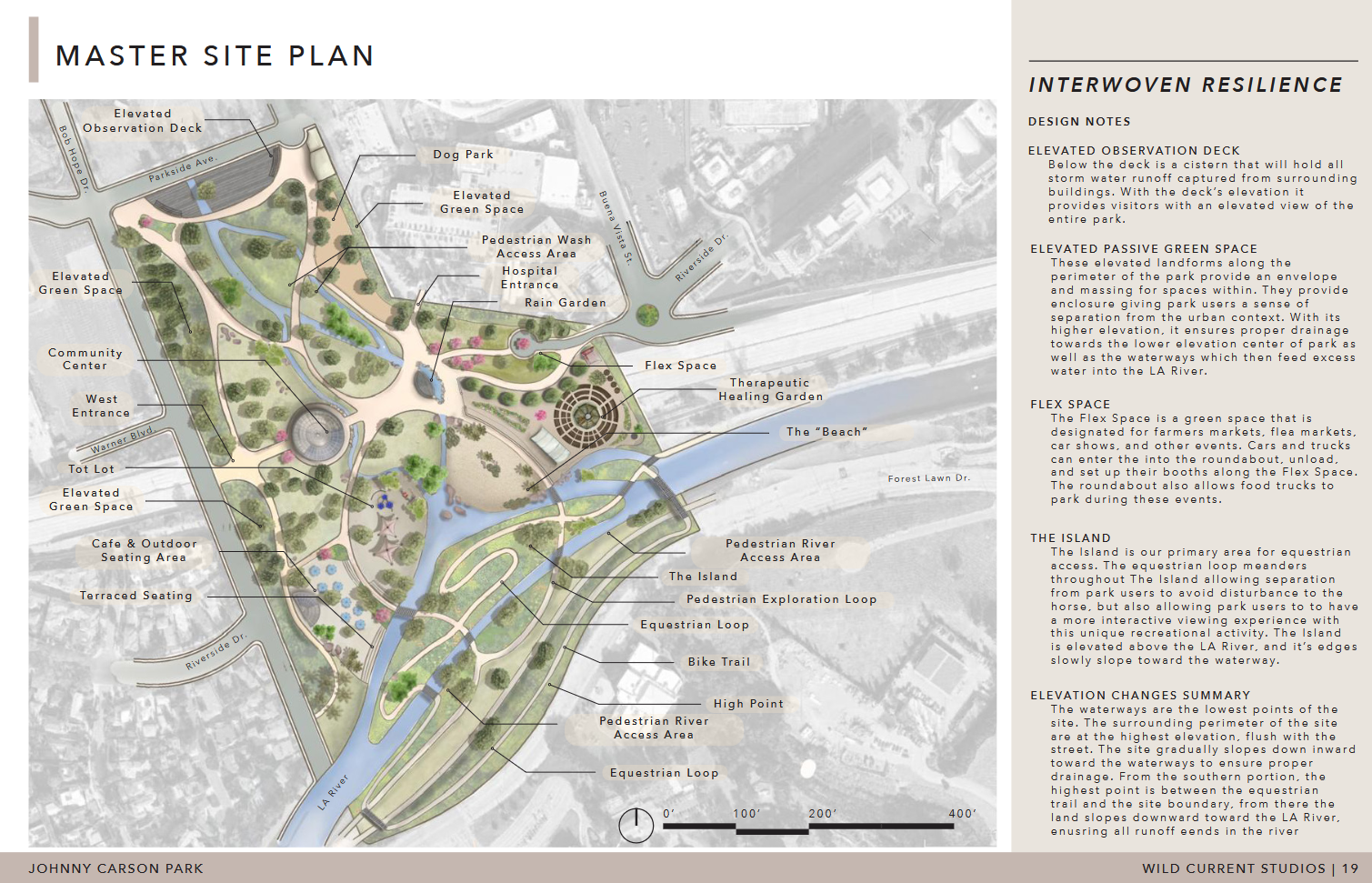
Bella Smith, Lauren Rupp,
Danielle Moncarz

SCASLA Honorable Mention
Judges commended the river intervention and felt that the freedom given to the river was a big swing and quite successful.
A redesign of Azusa Wilderness Park that focuses on the richness of place, community, and resilience, creating a refuge for both people and plants. It is inspired by the native basket weaving of this area. A basket serves as both a vessel and a craft, woven from strands of place, tradition, and use. In landscape, it is a powerful metaphor—a space that holds, gathers, and connects. Just as a basket is shaped by the tension between its warp and weft, landscapes can be designed through the interlacing of ecology and culture. This is the new Azusa Wilderness Park.
Johnny Carson Park Redesign
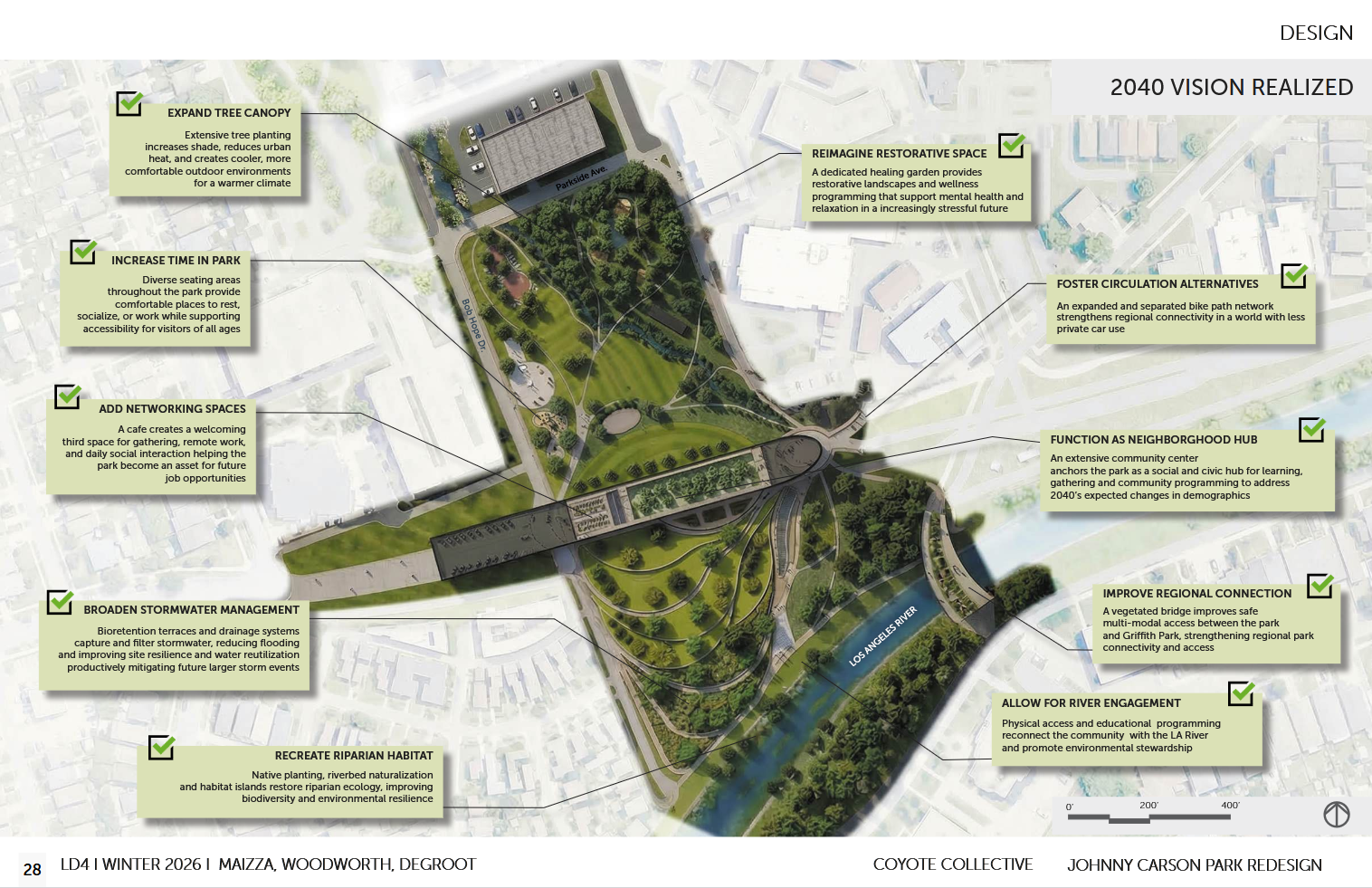
Tato Maizza, Kyra Degroot, Kelsey Woodworth
We were asked to redesign Johnny Carson Park in Burbank for the Future Users of 2040, focusing on people and programming. Other groups were asked to explore different angles in their designs.
Land, Legacy & Renewal
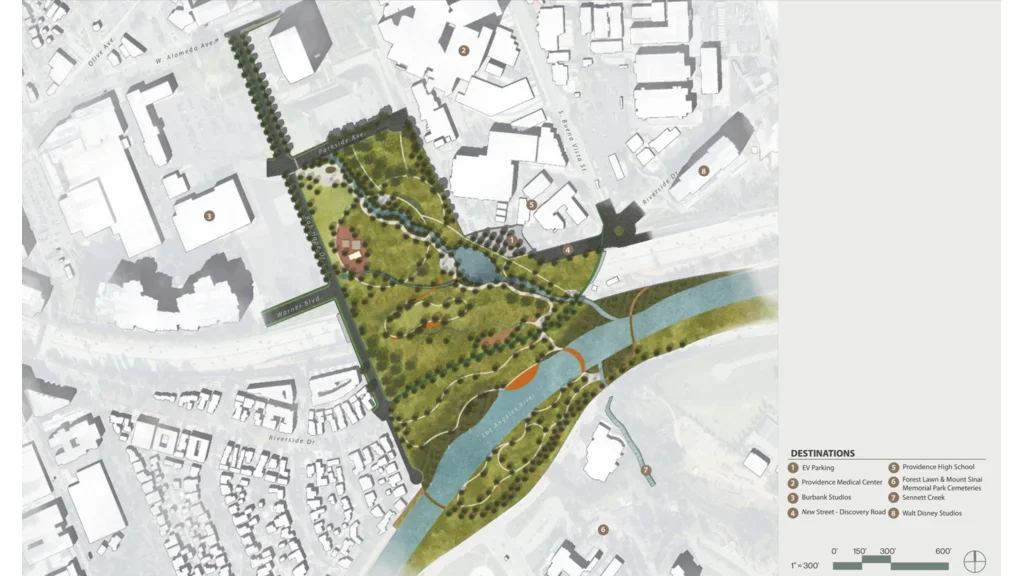
Ryan O’Leary Jones, Elisa Reclusado, Mario Calito
Environmental planning and analysis project reimagining Johnny Carson Park and the adjacent Los Angeles River in Burbank. The studio program placed the project in a future scenario in which the 134 Freeway had been decommissioned, opening a major piece of infrastructure and the fragmented land around it for reconsideration as public landscape. This team project included an in-depth study of the Indigenous landscape that existed long before the 134 Freeway, channelized river, and surrounding development around Johnny Carson Park. Research into Fernandeño Tataviam, Chumash, and Tongva relationships to the land examined historic movement routes, river-terrace settlements, seasonal hydrology, and the interconnected riparian, woodland, and grassland systems of the Los Angeles Basin. Those patterns became the foundation for the design, informing how people move through the park, where they gather, how they experience water, and how habitat is restored. The resulting River Discovery Trail reconnects the park physically, ecologically, and experientially to the Los Angeles River, using the landscape itself to teach about the systems and histories that shaped the site.